
[This is part of a series of articles where eKompass will share tips, tricks and experiences from the industry. Click here to read part 1]
Order Integration (EDI)
The basic idea of an order integration is to streamline a process, reduce manual handling and minimize the risk of errors occurring.
Simplified, we can say that an order integration consists of two steps,
Step 1: How should the customer access the product/range?
Step 2: How should the order be handled?
Step 1
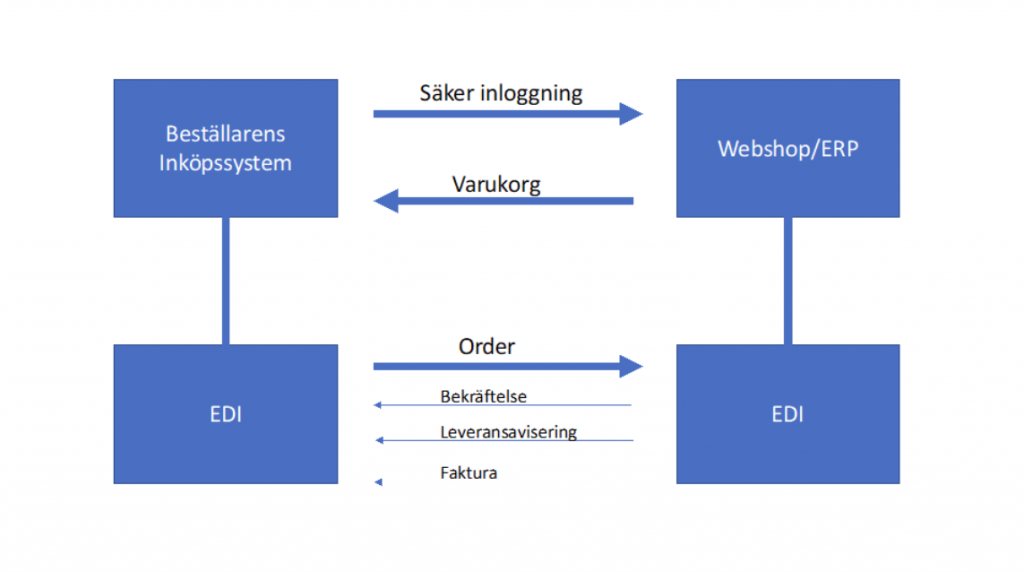
A common way is to send an electronic product catalog to the customer's purchasing system at a scheduled time interval. It usually contains the product's article number, name, product description, customer-specific prices and possibly links to product images. Based on this, the user then sees the product in their own system.
This way of trading is sometimes perceived as a simple and smooth way in that part of this approach is automated.
Another approach is a so-called "Punchout".
It is a solution that means that the customer, via a link from their purchasing system, becomes "directly logged in" and sees their contract prices directly in the supplier's webshop. The customer then places the products in the shopping cart, which are then sent back to the customer's purchasing system.
The biggest advantage of this solution is if the customer wants access to a large range. Price updates always happen in real time. In addition to this, there is also a good opportunity to use the webshop's functions, e.g. search function and product guides.
step 2
How an order is sent depends primarily on the options the customer's purchasing system offers (examples: Visma Proceedo, Raindance, IBX, Amesto, etc.). A good tip here is to always try to integrate the purchase order via EDI (common formats are: XML and EDIFACT). If it is also possible to send with order confirmation, delivery notification and invoice, that is also preferable.
Automated handling provides faster and better quality in the information between the systems and this reduces the risk of errors and misunderstandings occurring. It also creates opportunities to handle larger order volumes at a lower handling cost.



 English (UK)
  Svenska